Special Edition - July 4th 1776
Discover Francis Alison - Patriot, Scholar and Theologian
Francis Alison Writings: Preserving the Past, Enlightening Our Future
Discover Francis Alison - Patriot, Scholar and Theologian
While today's influencers use social media to shape public opinion, the influencers and shapers of the Revolution were teachers like Alison who taught philosophy and critical thinking as well as theology to the delegates. Three of the fifty-six signers of the Declaration of Independence were his students, as well as the Secretary of the Continental Congress and one of its presidents. He and Ben Franklin knew each other well; Franklin admired his work. George Washington and John Adams knew him and occasionally worshiped with him and heard him preach. He corresponded with the most prodigious minds in the Colonies, not only on politics but on religion, the classics and even natural sciences.
If a teacher can be judged by the quality of the students taught, Alison is in the pantheon of great teachers. He started his academy in New London, PA a few miles above the Maryland and Delaware borders. This academy based on Allison's methods would become the University of Delaware. His first class of students was (according to historian John Munroe) “possibly the most distinguished in terms of the later achievements of its members, taken as a whole, of any class in any school in America.” Those students, from all walks of life, would go on to become statesmen, doctors, merchants and scholars. Alison's students Thomas McKean, George Read and James Smith signed the Declaration of Independence. Read also signed the U.S. Constitution. A fourth student, Charles Thompson, was the secretary of the Continental Congress for its full fifteen-year history, Thompson also designed the Great Seal of the United States and was sent by Congress to inform George Washington of his election as the first President of the United States.
At Alison's death, one of his earliest students, Matthew Wilson concluded, "It is plain Dr. Alison was the principal father of learning and learned men [in Colonial America] and like Prometheus, Cadmus, or even Apollo of old, deserves perpetual remembrance,. as one of the greatest public benefactors, on whose urn every grateful Son of Science will drop a tear." [Wilson's full 2,431-word "Character Study" may be found elsewhere on this website.].
Copyright (c) 2026 Francis Alison Foundation. All Rights Reserved.

Anyone who has ever visited Philadelphia in the summer knows that it can be hazy, hot and humid; the summer of 2025 was one such summer with highs in the nineties and no cooling breeze, much like the summer of 1776..
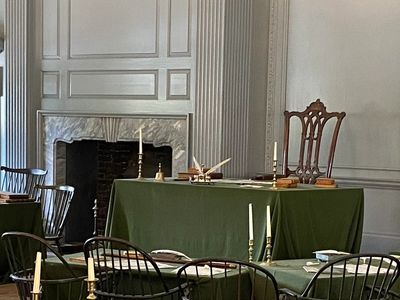
Imagine, then, having 56 Delegates (plus Secretaries and aides) housed in a hot, stuffy forty-foot-square (1,600 sq.ft) room debating what the Thirteen Colonies should do to respond to indignities suffered from the British Crown.
Windows were shut tight to prevent detection by the Crown's spies. Charges of Sedition if they were caught, were a real danger. So they sat in the drenching heat in wool coats with wigs on, debating.
Although all the colonies were united in their opposition to the Crown's overreach, they had different approaches to deal with it. Heated debates were common; tempers flared and even canings occurred.
Pennsylvania was the "Keystone" of the colonies; Philadelphia was the colonial hub of activities. Pennsylvania was, therefore, more aligned with the Crown than others. It was not a foregone conclusion that they would sign the Declaration.
According to one eyewitness, “The state of Pennsylvania on the 4th of July (there being only five members present; Messrs. Dickinson and Morris, who had in the committee of the whole voted against Independence were absent) voted for [independence], three to two .... Unanimity in the thirteen states, an all-important point on so great an occasion, was thus obtained; the dissension of a single state might have produced very dangerous consequences."
Thus, the absence of two delegates from Pennsylvania allowed the passage of the Declaration!
Copyright (c) 2026 Francis Alison Foundation. All Rights Reserved.
Charles Thompson, a student of Francis Alison (and later an instructor under him) was the Secretary of the Continental Congress for its entire fifteen years, As such it was Thomson's prerogative as to what would be included in the official Journals of the Continental Congress. After leaving office, he chose to destroy the work in an effort to preserve the perception that the leaders of the Revolution were all heroes and stated his desire to avoid "contradict[ing] all the histories of the great events of the Revolution. Let the world admire the supposed wisdom and valor of our great men. Perhaps they may adopt the qualities that have been ascribed to them, and thus good may be done. I shall not undeceive* future generations." Today, historians have to rely on the diaries and letters of the 56 delegates to get a better understanding as to what actually went on during the momentous months of June and July 1776.
*Thompson's double negative here means that he chooses to deceive.
Only two names that appeared on the first printed copy of the Declaration of Independence published July 8th:
John Hancock, the President of the Congress, and Charles Thomson, who in his role as Secretary of the Continental Congress, attested to it.
On August 22, 1813, Thomas McKean (a signer of the Declaration and student of Francis Alison) wrote to the nephew of another signer:
“ I will tell you some truths not generally known: In the printed public journal... it would appear, that the Declaration of Independence was signed on the 4th of July by the members whose names are there inserted, but the fact is not so, for no person signed it on that day, nor for many days after, and among the names subscribed, one was against it. Mr Read and seven [others] were not in Congress on that day (Morris, Rush, Clymer, Smith, Taylor, Ross [all] of PA, and Thornton of NH); nor were the six gentlemen last named at that time members; the five for Pennsylvania were appointed Delegates by the Convention of that state on the 20th of July, and Mr. Thornton entered Congress for the first time on the 4th of November following, [while] the names of Wisner of New York, and Thomas McKean of Delaware are not printed as subscribers, though both were present, and voted for Independence."
Copyright (c) 2026 Francis Alison Foundation. All Rights Reserved.
The bell, with the words "Proclaim LIBERTY throughout all the Land and to all its inhabitants Thereof" was cast in 1752 for the Pennsylvania Legislature by British bell makers but had problems from the start mainly because of the specific amalgam of metals used. It cracked when it was first rung and had to be recast twice. As it was in the belfry of the Pennsylvania State House (now Independence Hall) in July 1776, it may have been rung on July 8th during the public proclamation of the printed Declaration of Independence.
Abolitionists in the 1830's adopted it as a symbol, calling it the "Liberty Bell," and it got its great crack sometime around 1841-45 most likely when being rung either for Independence Day or Washington's Birthday.
The Liberty Bell, the most visible symbol of the Revolution, is now housed in its own pavilion on Independence Mall and is one of the most visited sites in Philadelphia.

The FRANCIS ALISON FOUNDATION's Main Purpose is two-fold:
"I beg a place in your patriotic Journal for the Character of one of the Greatest Men of America, drawn as briefly as I could, with some hints which may be useful at this time, when Seminaries of Learning, while demolish’d by the ungenerous English, are ready to be established. I hope, on broader bottoms, and better foundations, than before. ••• I boldly prophesy that Learning, as well as Liberty are first to arrive as the highest possible summit of perfection in the Columbian States.
But in order to [do] this the Seats of the Muses must be removed to the remotest distances from the proud, immoral; luxurious and effeminate cities to some poor, honest, laborious villages, where the Lacedemonian virtues, with Dr. Alison's unequalled assiduity and most successful method of teaching, the Belles Lettres, etc, may be secured by the Laws of Congress, and rendered immutable, as those of the Meades and Persians.
I doubt not you will, for this most important purpose, devote a column or two of your valuable Paper to publish this Character ..."
Keep reading this Character Study by clicking the button below.
Copyright (c) 2026 Francis Alison Foundation. All Rights Reserved.
Existing as a dream as far back as 1968, the germ of the creation of francisalison.org took place with a multigenerational gathering of his descendants (including a centarian!) in 2021, and the acquisition of the francisalison domains (.org, .com and .net) in 2023.
Since that time we have forged and focused our mission.

Founded officially in 2023, and incorporated as a Delaware corporation in 2026, The Francis Alison Foundation (francisalison.org) is dedicated to preserving and sharing the history, thoughts and writings [to, from and about] the Rev. Dr. Francis Alison, Sr. who taught signers of the Declaration of Independence as well as framers of the Constitution and who also worked to preserve religious freedom in America.
Copyright (c) 2026 Francis Alison Foundation. All Rights Reserved.

We are now official!
The Francis Alison Foundation, LLC is now incorporated as a Delaware Corporation! While our non-profit status is still in progress, our goal is still the same.
As we build this site, we plan to offer a variety of educational programs for all ages online. For now, feel free to explore our current online resources.
There are three main spellings for Alison as shown above, and as spelling was not standardized in the 18th century, people spelled it the way it sounded to them.
Mainly hailing from the Northern Ireland counties of Ulster and Donegal, people named Alison came to New England first.
When the Puritans forbade them from staying in Massachusetts, they moved first to New Hampshire (where, for example, they founded Londonderry, NH) and Maine and from there spread out, especially after a number of severe New England winters. Many of them moved to Pennsylvania, Maryland and the Carolinas.
While our focus is on Francis Alison (and his siblings), we do retain data concerning Alison families not in our direct line and we will endeavor to answer any questions you may have regarding the Alisons.
Copyright (c) 2026 Francis Alison Foundation. All Rights Reserved.
Francis Alison is consistently described in 19th-century biographical sources as a slaveholder who used his will to free the people he held. Most sources say that when he died in Philadelphia, November 28, 1779, at age 74, "he left directions in his will for the emancipation of all his slaves."
What does this mean for us?
1. Ownership – The phrasing "all his slaves" presumes he held enslaved people during his lifetime in Pennsylvania. Philadelphia in the 1750s–1770s still permitted slavery; Alison, as a prominent minister and educator with a household in the city and earlier a farm-school near New London, PA, would have been in a social stratum where slaveholding was common.
2. Manumission. Alison did not free slaves during his life. The emancipation was testamentary — instructions written into his 1779 will, to take effect after his death on 28 November 1779.
What we don't know from the available sources:
• Number or names. Historians give no count or names of slaves, and no digitized copy of the will names individuals.
• Timing or conditions. 18th-century Pennsylvania wills often stipulated gradual freedom ("at age 21," "after serving my wife," etc.). The sources say only "directions... for the emancipation," not whether it was immediate.
• Context. Alison died just months before Pennsylvania's 1780 Gradual Abolition Act. His decision to free slaves fits a pattern among some Revolutionary-era Presbyterian and Quaker-influenced Philadelphians who began to view slavery as incompatible with their rhetoric about liberty. Alison famously wrote in 1775 that Parliament could "never enslave us."